Clearly, I enjoy making life hard for myself.
I have absolutely no doubt that there are plenty of beginning sewing guides equivalent to The Retard’s Guide to Sewing, or online forums, etc., that I could and probably should be perusing at this point in my career as a seamstress (or tailoress…or mantua maker…or modiste. The old words were so fun! Yay for historical romance novels that have taught me all of them!). But because none of the stupid itsy bitsy should-be-self-evident-but-apparently-aren’t-because-I’m-“special”-like-this pieces of information are on the surfaces of such sites/forums/books that I’ve perused, I’m basically reinventing the wheel and figuring out what generations of tailors learned long ago about things like how to stitch more quickly, and how to sew in straight lines, and how long to make your sewing thread, and how to tie off ends. (I’m still working on some of these.)
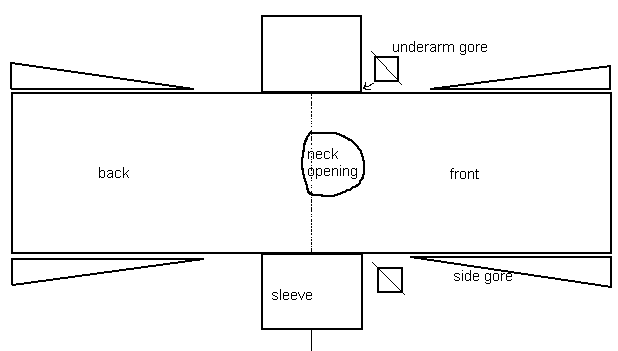
Over the last 10 days or so, I have been hand-sewing at my chemise. I learned how to make basting stitches super-fast by popping the thread in and out of the fabric like a sine wave and then pulling it through and pulling it tight. Voila! I can cover 10 inches in about five minutes.
Then I read a statistic from history-girl that said the shifts she examined had about 18-20 stitches per inch…my basting stitches had about 8. WAY too long! I tried making the movements in and out smaller, but in order to get them at that 18-20/inch scale I was working as slowly as I would be to just pull the thread in and out every time. So then I started doing about 6 short running stitches (which, like basting stitches, are just in and out of the fabric…a bit of the ole in-and-out, as Anthony Burgess might put it) at a time before pulling the thread tight. It pulls the fabric a bit, but for an underdress or completely hidden seam that’s okay—and it’s not a whole lot worse than putting in stitches one by one, anyway. The multi-stitch, then pull, method isn’t as fast the basting, but still faster than pulling the thread on every stitch.
So that took care of getting my stitches the right size and a reasonable work rate.
Then I noticed how atrociously out of alignment my seam was. In a general way, at a macro level I mean, it was fine—but up close…totally schizophrenic! Up and down, some at angles, some straight, and none of them consistent in size. Utter mess! So I wondered, what would happen if I drew myself a line and sewed along that? I tried it, and, boom! Even line! No more angles (for the most part). It even made my stitch lengths more even, and what the fuck difference would a line make to that? Note on this: Use a pencil! The thinnest-leaded pencil you can find! (1) Even a thin guideline can make an uneven row of stitches if you're drifting from the top of it to the bottom of it. (2) Pen will bleed into your thread after repeated pulls through it, and you don't want gray thread in a white fabric!
I was very proud of myself for thinking of this draw-a-line thing for about 10 seconds. Then I realized that it was probably the method of choice even for peasant housewives sewing their own shapeless sacks, and felt kind of dumb for not bothering to track down that information somewhere before starting. In many ways I’m still sewing like a child—literally, as someone who understands only the most basic of the mechanics but not the whys, the hows, and certainly not the means to refine them.
 Like I said. I’m reinventing the wheel. And being hard-headed and enjoying making this as difficult for myself as I possibly can, instead of just reading a lot of what I already do know in order to find out what I don't. Sewing for Retards, indeed….
I have absolutely no doubt that there are plenty of beginning sewing guides equivalent to The Retard’s Guide to Sewing, or online forums, etc., that I could and probably should be perusing at this point in my career as a seamstress (or tailoress…or mantua maker…or modiste. The old words were so fun! Yay for historical romance novels that have taught me all of them!). But because none of the stupid itsy bitsy should-be-self-evident-but-apparently-aren’t-because-I’m-“special”-like-this pieces of information are on the surfaces of such sites/forums/books that I’ve perused, I’m basically reinventing the wheel and figuring out what generations of tailors learned long ago about things like how to stitch more quickly, and how to sew in straight lines, and how long to make your sewing thread, and how to tie off ends. (I’m still working on some of these.)
Over the last 10 days or so, I have been hand-sewing at my chemise. I learned how to make basting stitches super-fast by popping the thread in and out of the fabric like a sine wave and then pulling it through and pulling it tight. Voila! I can cover 10 inches in about five minutes.
Then I read a statistic from history-girl that said the shifts she examined had about 18-20 stitches per inch…my basting stitches had about 8. WAY too long! I tried making the movements in and out smaller, but in order to get them at that 18-20/inch scale I was working as slowly as I would be to just pull the thread in and out every time. So then I started doing about 6 short running stitches (which, like basting stitches, are just in and out of the fabric…a bit of the ole in-and-out, as Anthony Burgess might put it) at a time before pulling the thread tight. It pulls the fabric a bit, but for an underdress or completely hidden seam that’s okay—and it’s not a whole lot worse than putting in stitches one by one, anyway. The multi-stitch, then pull, method isn’t as fast the basting, but still faster than pulling the thread on every stitch.
So that took care of getting my stitches the right size and a reasonable work rate.
Then I noticed how atrociously out of alignment my seam was. In a general way, at a macro level I mean, it was fine—but up close…totally schizophrenic! Up and down, some at angles, some straight, and none of them consistent in size. Utter mess! So I wondered, what would happen if I drew myself a line and sewed along that? I tried it, and, boom! Even line! No more angles (for the most part). It even made my stitch lengths more even, and what the fuck difference would a line make to that? Note on this: Use a pencil! The thinnest-leaded pencil you can find! (1) Even a thin guideline can make an uneven row of stitches if you're drifting from the top of it to the bottom of it. (2) Pen will bleed into your thread after repeated pulls through it, and you don't want gray thread in a white fabric!
I was very proud of myself for thinking of this draw-a-line thing for about 10 seconds. Then I realized that it was probably the method of choice even for peasant housewives sewing their own shapeless sacks, and felt kind of dumb for not bothering to track down that information somewhere before starting. In many ways I’m still sewing like a child—literally, as someone who understands only the most basic of the mechanics but not the whys, the hows, and certainly not the means to refine them.
 Like I said. I’m reinventing the wheel. And being hard-headed and enjoying making this as difficult for myself as I possibly can, instead of just reading a lot of what I already do know in order to find out what I don't. Sewing for Retards, indeed….